How acupuncture may ease sciatica and radiating nerve pain, what the evidence shows, and how many sessions to expect.
When Sitting Down Feels Like a Threat
You know the pain I mean — it doesn’t stay in one place, but it is also unrelenting. It starts low in the back or hip and travels, hot and electric, down the back of the leg. Sitting through a meeting becomes an exercise in bracing. Getting out of the car requires a plan. Sleep gets shallow because there’s no position that you can truly relax into. Sciatica isn’t just “back pain” to the people living with it — it’s the slow leak to your quality of life. The walk you used to take without thinking about it. The patience you used to have with your family at 6pm. The sense that your body is a place you can trust.
What’s Actually Happening, and Why Acupuncture Helps
Sciatica happens when the sciatic nerve, or the nerve roots that feed it, gets irritated or compressed — often from a disc, tight muscle, or inflammation pressing where it shouldn’t. Acupuncture appears to work on that irritation from more than one direction. Locally, it can ease the muscle spasm and tightness that’s adding pressure to the nerve, and improve circulation to tissue that’s been starved of it. Systemically, it seems to calm the inflammatory signaling that keeps a nerve “hot,” and it shifts how the spinal cord and brain are processing those pain signals in the first place — which is part of why people often feel calmer, not just less pain, after a treatment.
This isn’t just a nice theory. A 2025 review pooling 68 clinical trials and over 6,000 participants found acupuncture meaningfully improved resolution for sciatica, with real reductions in pain intensity and better function scores compared to standard care alone. It was also well tolerated, with side effects that were mild and infrequent. I’ll say with transparency that the underlying research is still maturing — trial quality varies, and acupuncture works best as part of a comprehensive plan rather than one single treatment. But the data across that many people and studies is consistent enough that I don’t hesitate to offer it.
Why We Look Past the Nerve
Here’s where I diverge from just “treating the sciatica.” In Chinese medicine, that band of pain running down the leg usually tracks along the Gallbladder or Bladder channel — though depending on exactly how it presents, the Stomach channel can be involved too, especially when the pain travels along the front or outer thigh rather than straight down the back of the leg. What we’re actually tracking is where Qi and Blood have stopped moving freely, and how that’s tangled up with the deeper balance of Yin and Yang underneath it. Qi is the movement, Blood is what nourishes the tissue it passes through, and pain in this framework is largely what happens when that flow gets obstructed — by an old injury, by how someone sits all day, by stress that never fully unwinds.
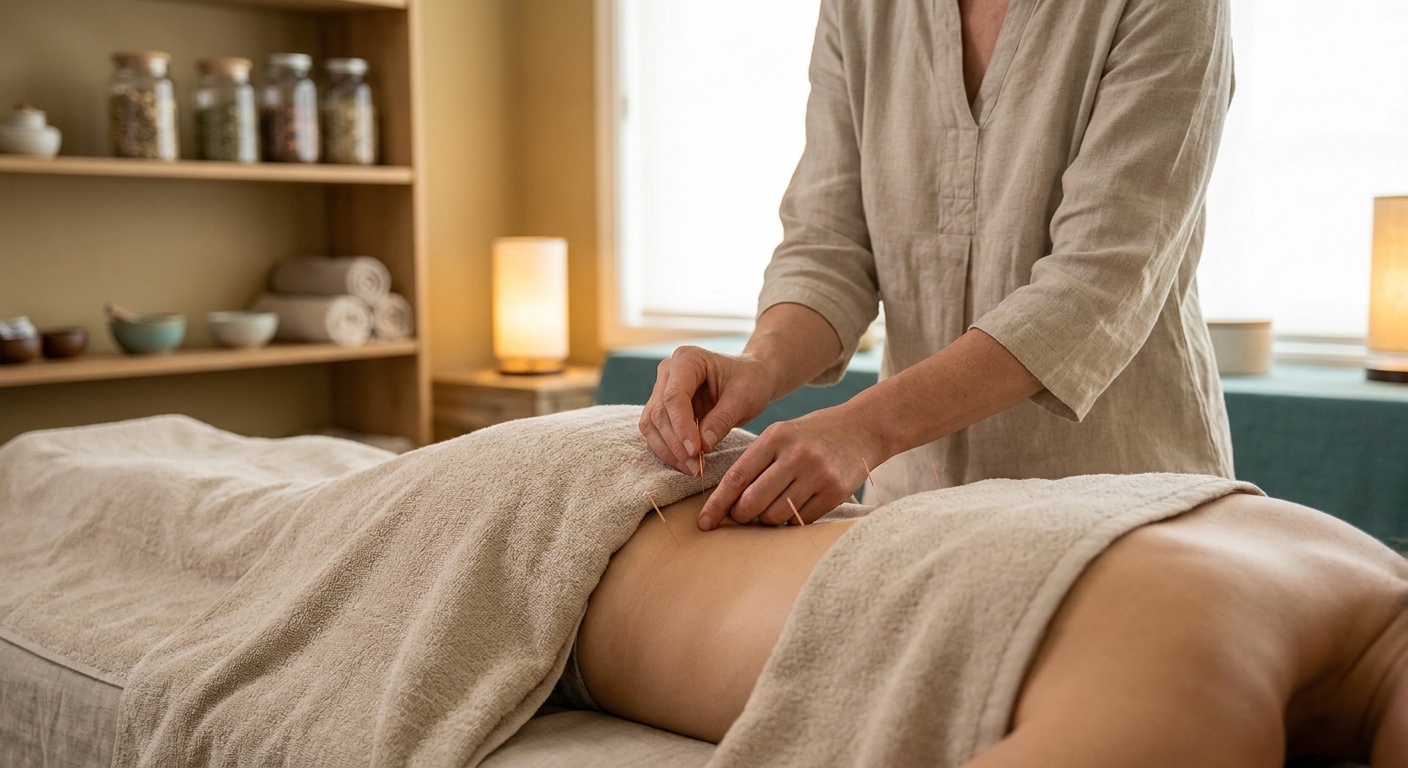
That’s also why treatment doesn’t always mean needling the spot that hurts. Sometimes we do treat locally, right at the site of pain. But just as often, we’ll also needle points far from the leg — in the hands, feet, low back, or ears — because moving Qi and Blood along a channel from a distance can release the local congestion more effectively than working the inflamed area alone. If it feels like we’ve skipped over the exact spot that’s screaming at you, that’s usually why.
There’s a physiological version of this too. Stress creates tension in the nervous system. That tension raises cortisol. Cortisol feeds inflammation. Inflammation keeps the nerve irritated and the muscles around it guarded, which feeds right back into more tension. Chinese medicine was mapping a version of that loop long before we had the word cortisol — it’s why we’re weighing the availability and flow of Qi, Blood, Yin, and Yang together, not just treating the inch of nerve that hurts.
What Getting Better Actually Looks Like
Most people notice some shift — less intensity, a better night’s sleep, more range before the pain kicks in — within the first two or three sessions. A full course is usually somewhere in the range of six to twelve visits over two to three months, though how quickly you move through that depends on how long you’ve been dealing with this and how your body responds. The goal isn’t only to make the pain stop — it’s to create enough space in the body that it remembers how to regulate itself. That’s why we usually ask you to see the plan through, even after the pain has already let up. That’s what keeps the relief from being temporary instead of just a good couple of weeks. And the real result isn’t just a lower number on a pain scale. It’s standing up from your desk without doing the math first. It’s playing with your kids on the floor again. It’s having an actual plan for what to do if this flares up again, instead of just waiting for the next bad week.
Ready to Get Out of Bracing Mode?
If this is the pain you’ve been living with, you don’t have to keep managing it alone. Book a visit at Art of Acupuncture and let’s take a real look at what’s driving it — and build a personalized plan to get you back in your body.